
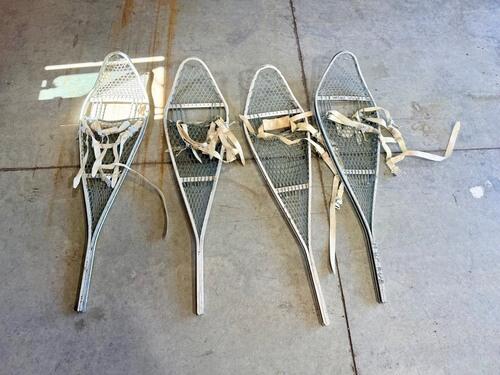
Military Surplus Snow Shoes, $125 for both pairs
Condition: New
Seller Type: Private Seller
Watching: 3
Views: 22
Military Surplus Snow Shoes, $125 for both pairs
These are military magnesium/aluminum trail snowshoes. They are the later Cold War-era issue type used by Canadian and U.S. forces after wooden snowshoes were phased out.
Construction
* Frame: Extruded magnesium alloy (sometimes described as magnesium/aluminum), finished in white baked enamel for snow camouflage. Welded joints and two welded crossbars keep the frame rigid.
* Decking: Nylon-coated steel or aluminum cable lattice (not rawhide). Heavier cable in the center load area, lighter cable toward the tip and tail.
* Shape: Classic long-tail "trail" pattern -- pointed/upturned tip, elongated body, and a distinct tail that helps the shoe track straight.
* Traction: Teeth or grip cleats on the underside of the frame.
* Bindings: Canvas/webbing harnesses with straps and metal buckles, made to fit issue winter boots. The toe pivots through the opening in the decking.
* Markings: One tail is marked "M 75 BLUE" (likely a size, unit, or inventory mark). Similar notation appears on at least one other shoe.
Typical issued size for this pattern is about 12" x 46" (30 x 115 cm). Rated load is commonly in the 170-250 lb range depending on snow conditions.
Role
These were standard winter mobility gear for patrol, reconnaissance, and movement in deep snow. The long tail favors distance travel and tracking; they are less handy in tight woods than short bearpaw/assault snowshoes. The magnesium frame is light, strong, and the underside can be scraped for emergency fire-starting shavings -- a feature often noted in military manuals.
Condition in the photo
Used surplus condition: faded white paint, worn canvas bindings, webbing still in place. Structurally they look complete as two pairs.
These are the white-painted magnesium trail snowshoes commonly sold as Canadian Forces / U.S. military surplus, not the older wooden 10th Mountain / Lund / Snocraft type.
These are military magnesium/aluminum trail snowshoes. They are the later Cold War-era issue type used by Canadian and U.S. forces after wooden snowshoes were phased out.
Construction
* Frame: Extruded magnesium alloy (sometimes described as magnesium/aluminum), finished in white baked enamel for snow camouflage. Welded joints and two welded crossbars keep the frame rigid.
* Decking: Nylon-coated steel or aluminum cable lattice (not rawhide). Heavier cable in the center load area, lighter cable toward the tip and tail.
* Shape: Classic long-tail "trail" pattern -- pointed/upturned tip, elongated body, and a distinct tail that helps the shoe track straight.
* Traction: Teeth or grip cleats on the underside of the frame.
* Bindings: Canvas/webbing harnesses with straps and metal buckles, made to fit issue winter boots. The toe pivots through the opening in the decking.
* Markings: One tail is marked "M 75 BLUE" (likely a size, unit, or inventory mark). Similar notation appears on at least one other shoe.
Typical issued size for this pattern is about 12" x 46" (30 x 115 cm). Rated load is commonly in the 170-250 lb range depending on snow conditions.
Role
These were standard winter mobility gear for patrol, reconnaissance, and movement in deep snow. The long tail favors distance travel and tracking; they are less handy in tight woods than short bearpaw/assault snowshoes. The magnesium frame is light, strong, and the underside can be scraped for emergency fire-starting shavings -- a feature often noted in military manuals.
Condition in the photo
Used surplus condition: faded white paint, worn canvas bindings, webbing still in place. Structurally they look complete as two pairs.
These are the white-painted magnesium trail snowshoes commonly sold as Canadian Forces / U.S. military surplus, not the older wooden 10th Mountain / Lund / Snocraft type.
Details
Snow Toys TypeSnowshoes







Video
No content
Map
Contact Steve
[Unavailable]
To contact this user via the Messaging System, Please Sign In or Create an Account.
Report Ad: Military Surplus Snow Shoes, $125 for both pairs
To report this Ad, please Sign In or Create
an Account.
Share this listing
Copy and paste the following URL for this listing
1 of 1